

Business opportunities in charging points
Published 28 May 2024 · Updated 3 September 2026

The shift to electric mobility is opening up business around the installation and management of charging points. Demand is growing in private and public settings, and with it the ways of making an installation pay. We go through the main ones, from the semi-fast charger in a car park to the charging station.
Installing semi-fast chargers
Semi-fast 7.4 kW chargers are the sensible option for offering charging in commercial car parks, service stations and residential developments. They charge a car in around 5 to 7 hours depending on the model, which is exactly as long as a working day or a night. It is the power rating of almost the whole charger range.
Making money through the OCPP protocol
The Open Charge Point Protocol (OCPP) allows chargers and a central management platform to talk to each other. With it you can monitor, manage and, above all, charge for the use of the chargers. The owner sets tariffs per kWh, per time used or a combination of both, and integrates payment by mobile app or card.
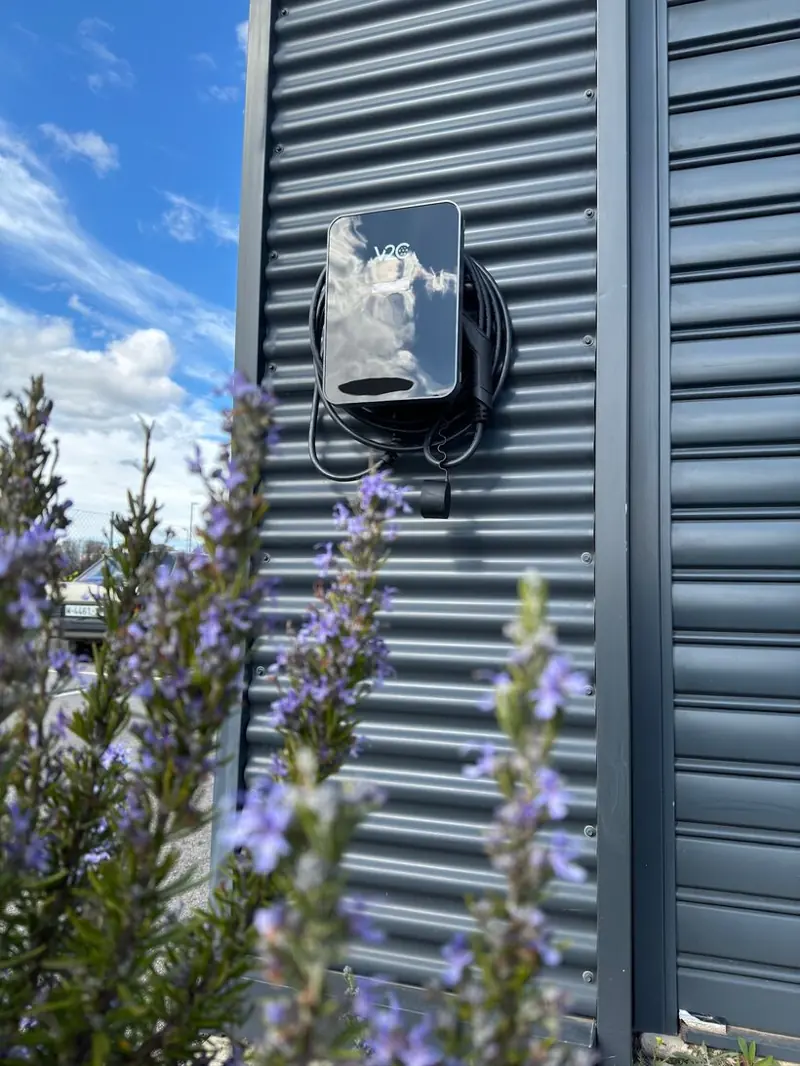
Not every unit speaks it. In our range the one that has it as standard is the V2C Trydan, with OCPP 1.6 JSON, and it is the one we fit when the installation has to hang off a third-party platform. The details are on the V2C Trydan page.
Mode 3 and mode 4 chargers in shared or public car parks
Installing in shared or public car parks is the other route. The modes refer to the type and speed of charging: mode 3 is alternating current charging up to 22 kW and mode 4 is fast direct current charging, which can reach 350 kW.
Billing and management
In a shared car park, the managing agent can pass the consumption on to each resident through RFID cards, a mobile app or monthly billing. That needs a unit that genuinely measures: the Orbis Viaris Uni Plus has an MID-certified energy meter and card activation, which is what is required when consumption has to be billed per user. It is on the Orbis Viaris Uni Plus page, and how an installation of this kind is approached is something we cover in installations in residents' associations.
In public car parks the tariffs can go by time used, by energy consumed or with a fixed charge per session.
Returns and payback
Mode 4 chargers cost considerably more because of their fast charging capability, but they also turn over more and support higher tariffs. The payback period varies a great deal with demand and the price of electricity, and for mode 3 installations people usually talk about a horizon of between 2 and 5 years.
Charging stations and the role of CPOs
Charging stations, or fast charging hubs, are a central piece of the ecosystem. They sit on through routes: motorways, service areas and shopping centres.
How charging stations work
They usually have several mode 4 fast chargers and add services around them, such as a shop or a café. The driver charges in 20 or 30 minutes, which makes them useful on a long journey.
Charging service providers
CPOs (Charge Point Operators) run the infrastructure, set the tariffs and take care of maintenance. In Spain, companies such as Endesa X, Iberdrola and Repsol operate in this segment with offerings that cover both the physical infrastructure and the management and payment platforms.
Land agreements and key locations
Location decides whether a charging station works. Land-use agreements in high-traffic areas are one of the most common levers for securing profitable sites.
Market tariffs and return on investment
The price per kWh at charging stations depends on the location, the type of charger and demand. In Spain it usually sits between €0.20 and €0.50 per kWh, and goes up for fast charging.
The return depends on how many sessions a day the site sustains. A point in a weak location takes years to pay for itself; one with high turnover and a good tariff does it far sooner. Before investing it is worth estimating real occupancy, not theoretical occupancy, and deducting the costs of operation, maintenance and the standing power charge.
Why accredited installers matter
Spanish regulations, and in particular the Low Voltage Electrotechnical Regulation (REBT), require electrical installations to be carried out by qualified professionals. An accredited installer guarantees that the whole thing complies with ITC-BT-52, the section specific to charging infrastructure, and that the installation is properly registered. We go into it in the article on why to choose an accredited installer.
The effect on electrifying the vehicle fleet
A dense network of charging points is a condition for the electric fleet to grow. As more drivers switch to electric, the availability of charging becomes the critical factor, and that is where the business gap appears.
Frequently asked questions
What is OCPP and why does it matter?
It is the communication standard that lets a charger and a management system understand each other even when they come from different manufacturers. Without it there is no decent billing or remote monitoring.
What does it cost to install a 7.4 kW semi-fast charger?
For a domestic or small business installation, between €1,450 and €1,950 all in: unit, materials, protective devices, labour, commissioning and registration. The prices by model are in the charger range.
What grants are there for installing charging points?
Two, and neither is MOVES III, which ended in 2025. The 15% income tax deduction, with a maximum base of €4,000, for installations finished before 31 December 2026. And the Energy Saving Certificate, €600, if you have bought an electric car and have scrapped or sold a combustion car that had been yours for more than a year. The conditions for each are in the article on grants currently available for installing a charging point ES.
Why do you need an accredited installer?
Because the installation has to comply with the REBT and be registered with the regional industry authority. A job with no certificate and no registration is not only an electrical risk: it leaves the installation outside the regulations and complicates any claim.
If you are running the numbers, in our calculators you can compare the running cost of an electric car against a combustion one and estimate charging times.
Can we help with your installation?
If you still have questions about your own case after reading this, tell us and we will look at it with no obligation.