

Charging points for electric vehicles
Published 15 February 2024 · Updated 3 September 2026
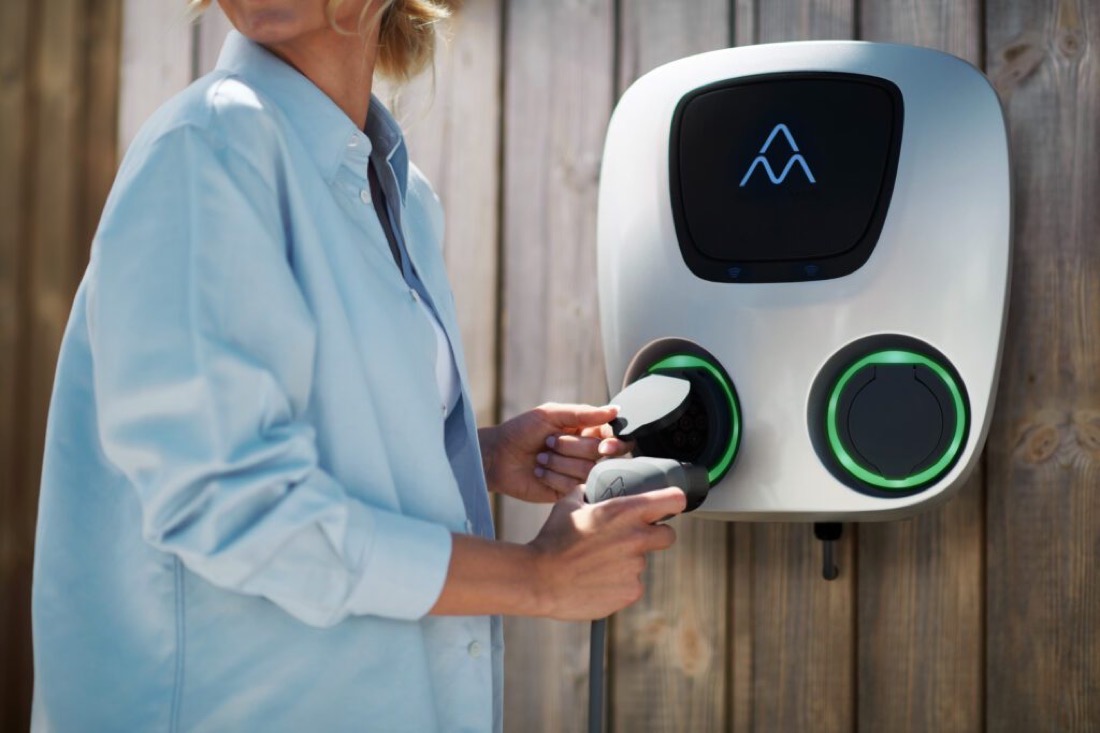
A charging point at home is what makes an electric car convenient and cheap. Without one you depend on the public network, which is dearer and less predictable. This article runs through the types there are, which one you need and what a properly executed installation must include.
Types of charging point
- Slow charging, up to 3.7 kW: the reinforced domestic socket. It works as a top-up, but filling a battery can take more than a day. It is not a solution.
- Semi-fast charging, 7.4 kW single-phase: this is the standard domestic installation. It leaves any battery ready overnight and needs no special supply connection.
- Semi-fast charging, 22 kW three-phase: for homes with a three-phase supply and for company car parks. Six models in the charger range reach this power level.
- Fast DC charging: from 50 kW upwards, for charging stations and service areas. It needs a supply connection that a home does not have.
Which one you need at home
For domestic use, 7.4 kW covers practically every case. At that power one night is enough to put back far more than a normal day's driving uses.
Going up to 22 kW only makes sense if you have a three-phase supply and the car accepts that much AC power, which is not usual. Many vehicles limit AC charging to 7.4 or 11 kW because of their on-board converter, so a more powerful charger would not charge any faster.
Dynamic load balancing and contracted power
It is the question that comes up most: whether you will need to increase your electricity contract. In the great majority of installations, no.
Dynamic load balancing measures what the home is using in real time and adjusts the charger's power so the total never exceeds your contracted limit. When the house is quiet the car charges at full power; when you switch the oven on the charger steps aside and catches up afterwards.
Not all units handle it the same way. On the Woltio Pro it comes as standard with the measuring probe included, as you can see on the Woltio Pro page; on the Tesla Wall Connector it is an optional accessory, according to the Tesla Wall Connector page.
What the installation must include
A serious quote is not just the price of the unit. It has to include:
- An initial survey: available power, the state of the consumer unit and the route to the parking space, before quoting a price.
- Materials and labour: cabling, conduit and any building work needed, at a fixed price.
- A dedicated protection panel: circuit breaker, residual current device and surge protection, to ITC-BT-52 of the REBT.
- Registration: electrical certificate and registration with the industry authority, in your name and once the job is done.
- Warranty: on the equipment and on the installation, which are not always the same.
Why each of these points matters is set out in the article on why to choose an accredited installer.
With solar panels
If you have solar panels there is one feature that changes the sums considerably: surplus charging. The charger detects the energy left over at midday and sends it to the car instead of exporting it to the grid. The Woltio Pro and the V2C Trydan have it as standard.
In a shared car park
When the space is in a block of flats there are two more things to resolve: the route from the meter room and individual consumption metering, so that everyone pays for their own. That is where equipment with an MID meter and card activation fits, such as the Orbis Viaris Uni Plus. The full procedure is in installations in residents' associations.
Prices and grants
A complete domestic installation comes to between €1,450 and €1,950 in most cases, including equipment, materials, protective devices, labour, commissioning and registration. The price per model is in the charger range and the differences between them, in the electric vehicle charger comparison.
Two grants currently available apply to that amount: the 15% income tax deduction, with a maximum base of €4,000 and a deadline of 31 December 2026, and the Energy Saving Certificate, €600, if you have bought an electric car and have scrapped or sold a combustion car that had been yours for more than a year. The requirements are in the article on grants currently available for installing a charging point ES.
If you want to run the numbers before deciding, in our calculators you can compare the running cost of an electric car against a combustion one and estimate the charging time for your model.
Can we help with your installation?
If you still have questions about your own case after reading this, tell us and we will look at it with no obligation.